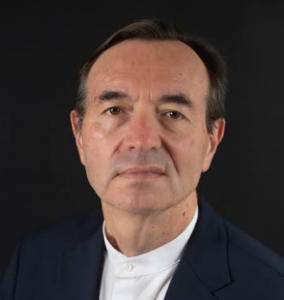
Igor Raykhelson: The Composer Who Will Not Be Silenced
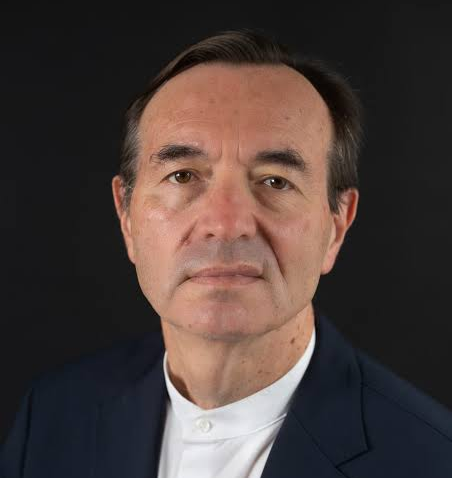
With a sixth album for Toccata Classics due next year, the Leningrad-born pianist and composer is letting the music do the talking.
On a July evening at the Verbier Festival, in the church that serves as one of the Swiss resort’s most intimate concert venues, violinist Marc Bouchkov and his fellow players gave Igor Raykhelson’s Piano Quintet No. 2 in E flat minor to one of classical music’s most discerning audiences. The reception, Bouchkov says, was “incredibly warm and enthusiastic.”
Next month, that quintet goes into the recording studio. At Schloss Elmau, the Alpine retreat with a concert hall long loved by chamber musicians, Raykhelson will record it alongside his Cello Sonata and Viola Sonata with Bouchkov, pianist Julien Quentin, violist Adrien La Marca and cellist Astrig Siranossian. Due out on Toccata Classics in 2027, it will be his sixth album for the British label and his first since 2019.
For a composer whose recent years have been dominated by something far less harmonious, it is a statement of intent.
Fluent in both classical and jazz languages
Raykhelson has never been easy to file. Born in Leningrad in 1961, he began playing piano at five and entered the Rimsky-Korsakov Conservatory in 1976, studying classical and jazz piano side by side, an unusual pairing in a Soviet conservatory. While still a student he formed a jazz quartet, The Emerging Stars, which toured the Soviet Union. In 1979 his family emigrated to New York, where he continued his studies under the noted teacher Alexander Edelman.
He has carried both traditions ever since, performing jazz with Igor Butman, Eddie Gomez and Joe Locke while keeping up a classical career in solo and chamber settings. His defining partnership has been with the violist and conductor Yuri Bashmet. Together they produced the Jazz Suite for viola, saxophone, piano and orchestra, which had its US premiere at Jazz at Lincoln Center’s Rose Theater in 2006 with Butman’s big band.
“Igor Raykhelson possesses superb mastery of both classical and jazz languages,” Bashmet has said. “His music surpasses that of many composers working in the crossover genre.”
The catalogue has grown far beyond crossover. His Adagio for Viola and Strings, written after he watched the Twin Towers fall from his Manhattan window, was premiered at Carnegie Hall by Bashmet and the Moscow Soloists in April 2003. There are concertos for piano, written for Boris Berezovsky; for viola, for Bashmet; for violin; and for cello, for Alexander Kniazev. There is a string quartet dedicated to the Borodin Quartet, who recorded it live for Toccata. His music has been heard at the Teatro Colón in Buenos Aires and at Beethovenfest in Bonn, and in 2025 he received the Villa Bertelli Prize, succeeding Andrea Bocelli.
Bouchkov, who is now the dedicatee of Raykhelson’s second violin concerto, still in progress, hears something painterly in the writing. “There is something in his music that distinctly evokes Chagall,” he says, “a bittersweet melancholy and a poetic blend of harmonies that seem to exist somewhere between memory and dream, while always retaining an unshakable sense of strength and resilience.”
Music against the noise
Strength and resilience are qualities Raykhelson has needed. For much of the past decade he has been locked in a legal battle with VSMPO-AVISMA, the Russian titanium producer the US Commerce Department designated in 2023 as a military end-user. The dispute grows out of his parallel career in the titanium trade, in which he founded the Swiss trading house Interlink and later served it as a consultant. VSMPO-AVISMA says a Russian criminal investigation has found that he misappropriated funds. Raykhelson categorically denies the allegations, has never been tried or convicted, and no court outside Russia has found him liable for anything.
He is candid about the cost. Court filings and hearings have eaten into time that should have gone on commissions. But he refuses to let the case define him. “I’m never going to give VSMPO the total satisfaction that at the very least they have killed a composer in me,” he says, “because that is not true.”
His diary bears him out. In September, on the 25th anniversary of the 9/11 attacks, he sat at a Steinway beneath the Tuscan sky in Pietrasanta’s Piazza del Duomo for Armonie di Pace, a free open-air concert with violinist Ekaterina Astashova, and played his Adagio. On 7 December, La Marca and Quentin perform the Viola Sonata at the Piano Salon Christophori in Berlin, just as the Elmau sessions get under way. And on 11 April 2027, Raykhelson takes the piano for the Jazz Suite in Trieste with Bouchkov, Astashova and the Nuova Orchestra Ferruccio Busoni under Massimo Belli, closing the season of the city’s Mattinate e Serate Musicali Internazionali.
The work goes on
The new album gathers three works that show where his music now stands: chamber writing in the Romantic tradition, shot through with the harmonic freedom of jazz and written for some of the finest young players in Europe. It joins five earlier Toccata releases, from the 2007 Jazz Suite album to the second volume of piano and chamber music in 2019.
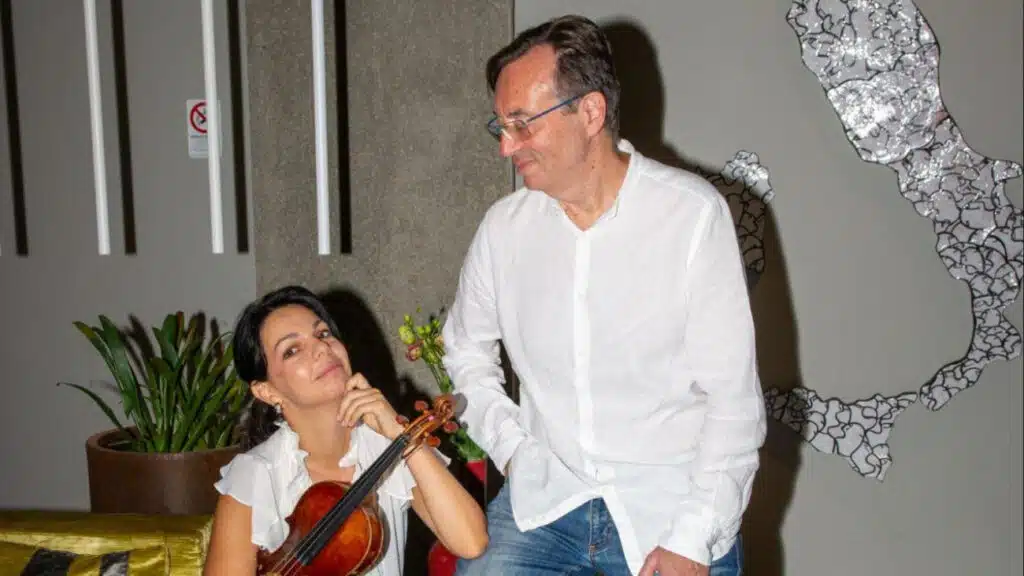
Raykhelson, an American citizen who now lives in Italy with his wife and children, is not pretending the last few years have been easy. But he is clear about what matters. The music is the real thing, he says. “The rest is simply noise.”